Toric IOL Lenses for Astigmatism – Complete Guide
Toric IOL Lenses: High-Precision Astigmatism Correction – And How to Know If They’re Right for You
If you have astigmatism and are planning cataract surgery or lens replacement, you don’t just want to remove the cloudy lens – you want clear, sharp vision afterwards, with as little dependence on glasses as possible.
That’s exactly where Toric IOL lenses for astigmatism come in. These Toric intraocular lenses (Toric IOLs) are designed to correct pre-existing corneal astigmatism at the time of cataract surgery, and multiple clinical reviews have confirmed that they improve uncorrected distance vision and reduce residual astigmatism compared with standard monofocal lenses.
This guide is for education only and does not replace a full eye examination with an ophthalmologist.
What is astigmatism – and why does it blur vision?
Astigmatism is a refractive error where the cornea or natural lens is not evenly curved – more like a rugby ball than a perfectly round football. Because of this irregular curvature, light rays entering the eye do not focus on a single point on the retina. Instead, they focus at multiple points, leading to:
Blurred or distorted vision at all distances
Ghosting or double contours around objects
Halos or streaks around lights, especially at night
Eye strain and headaches in some people
Glasses or contact lenses with a cylindrical (astigmatic) component can correct this, but when you are already having cataract surgery, it often makes sense to treat astigmatism inside the eye using a Toric IOL.
What is a Toric IOL – and how does it correct astigmatism?
A Toric IOL (Toric Intraocular Lens) is an artificial lens implanted inside the eye during cataract surgery or refractive lens exchange. Unlike a standard monofocal lens, which has the same focusing power in all directions, a Toric IOL has different refractive power in different meridians, just like a toric spectacle or contact lens.
In practical terms, that means:
It replaces the cloudy natural lens (cataract)
It corrects spherical error (myopia or hyperopia)
It simultaneously corrects corneal astigmatism – often from about 1.0 diopter and above, depending on the lens model and calculations
Because the Toric IOL must cancel the astigmatism along a specific axis, the surgeon has to align the lens precisely during surgery. Modern studies show that, with accurate marking and modern alignment systems, average postoperative rotation is small (a few degrees) and has minimal effect on visual outcomes in most patients.
How do Toric IOL lenses for astigmatism compare to standard monofocal lenses?
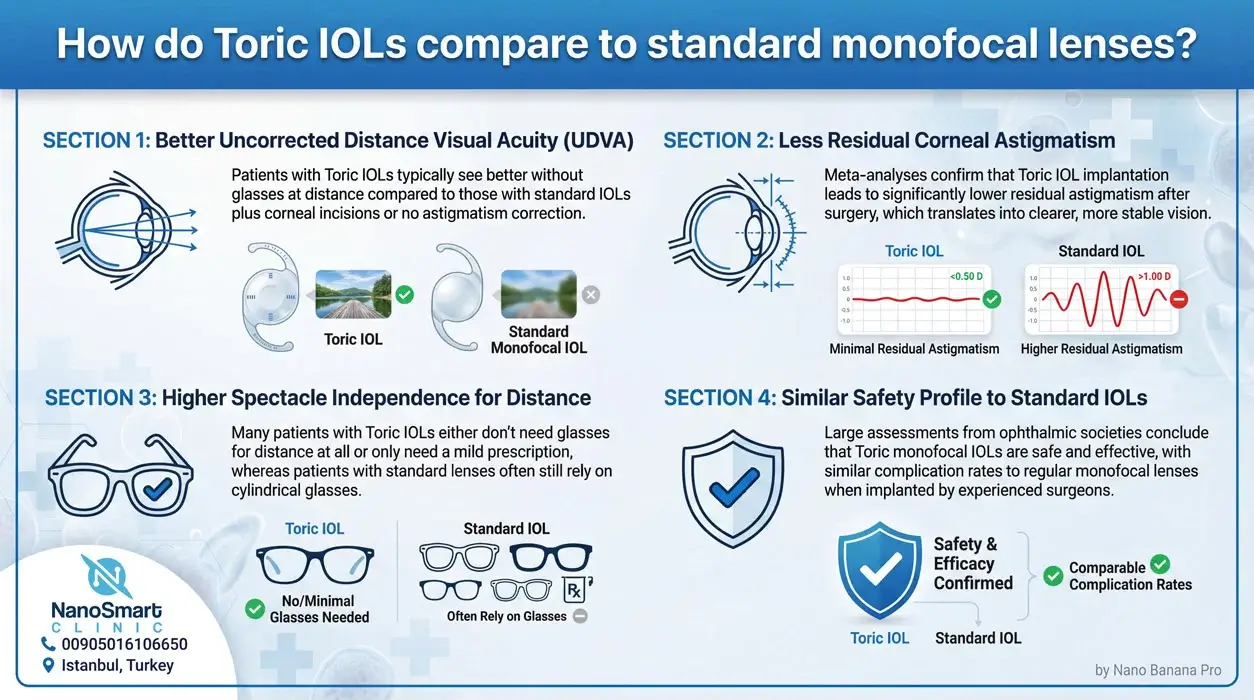
Several high-quality reviews and randomized trials have compared Toric vs. non-Toric (standard) monofocal IOLs in cataract patients with pre-existing astigmatism. Overall, they consistently show that Toric IOL lenses for astigmatism provide:
1. Better uncorrected distance visual acuity (UDVA)
Patients with Toric IOLs typically see better without glasses at distance compared to those with standard IOLs plus corneal incisions or no astigmatism correction.
2. Less residual corneal astigmatism
Meta-analyses confirm that Toric IOL implantation leads to significantly lower residual astigmatism after surgery, which translates into clearer, more stable vision.
3. Higher spectacle independence for distance
Many patients with Toric IOL lenses for astigmatism either don’t need glasses for distance at all or only need a mild prescription, whereas patients with standard lenses often still rely on cylindrical glasses.
4. Similar safety profile to standard IOLs
Large assessments from ophthalmic societies conclude that Toric monofocal IOLs are safe and effective, with similar complication rates to regular monofocal lenses when implanted by experienced surgeons.
When do guidelines recommend Toric IOL lenses for astigmatism?
The European Society of Cataract and Refractive Surgeons (ESCRS) and other expert groups have issued evidence-based recommendations on when Toric IOLs should be considered:
Toric IOLs may be considered in eyes with regular corneal astigmatism
They should be considered when corneal astigmatism is 1.0 diopter or more
The greatest clinical benefit is often seen when corneal astigmatism exceeds 2.0 diopters
In other words: if you have measurable, regular corneal astigmatism and you are already having cataract or lens surgery, there is strong evidence that Toric IOL lenses for astigmatism can significantly improve your unaided distance vision and reduce your dependence on glasses.
For further medical details, you can also review the cataract surgery guideline from the European Society of Cataract and Refractive Surgeons (ESCRS) and the American Academy of Ophthalmology’s overview on Toric IOLs.
Who is a good candidate for Toric IOL lenses for astigmatism?
Articles from the American Academy of Ophthalmology and recent reviews highlight the ideal Toric IOL candidate profile. Good candidates typically have:
Regular (not highly irregular) corneal astigmatism
Corneal measurements that are consistent and repeatable
A planned cataract operation or lens exchange
A strong desire to reduce dependence on distance glasses
Attention to eye health (no advanced macular disease, severe optic nerve damage, or uncontrolled ocular inflammation)
Toric IOLs may be less suitable if:
There is advanced keratoconus or markedly irregular astigmatism
There are large corneal scars or unstable corneal shape
The eye has advanced diseases of the retina or optic nerve that significantly limit potential vision
Dry eye disease is severe and unstable, making measurements unreliable
In borderline cases, the decision is individual: some surgeons do use Toric IOLs in carefully selected keratoconic or post-refractive eyes, but only if the cornea is stable and the central astigmatism is reasonably regular.
Your journey with a Toric IOL: step-by-step
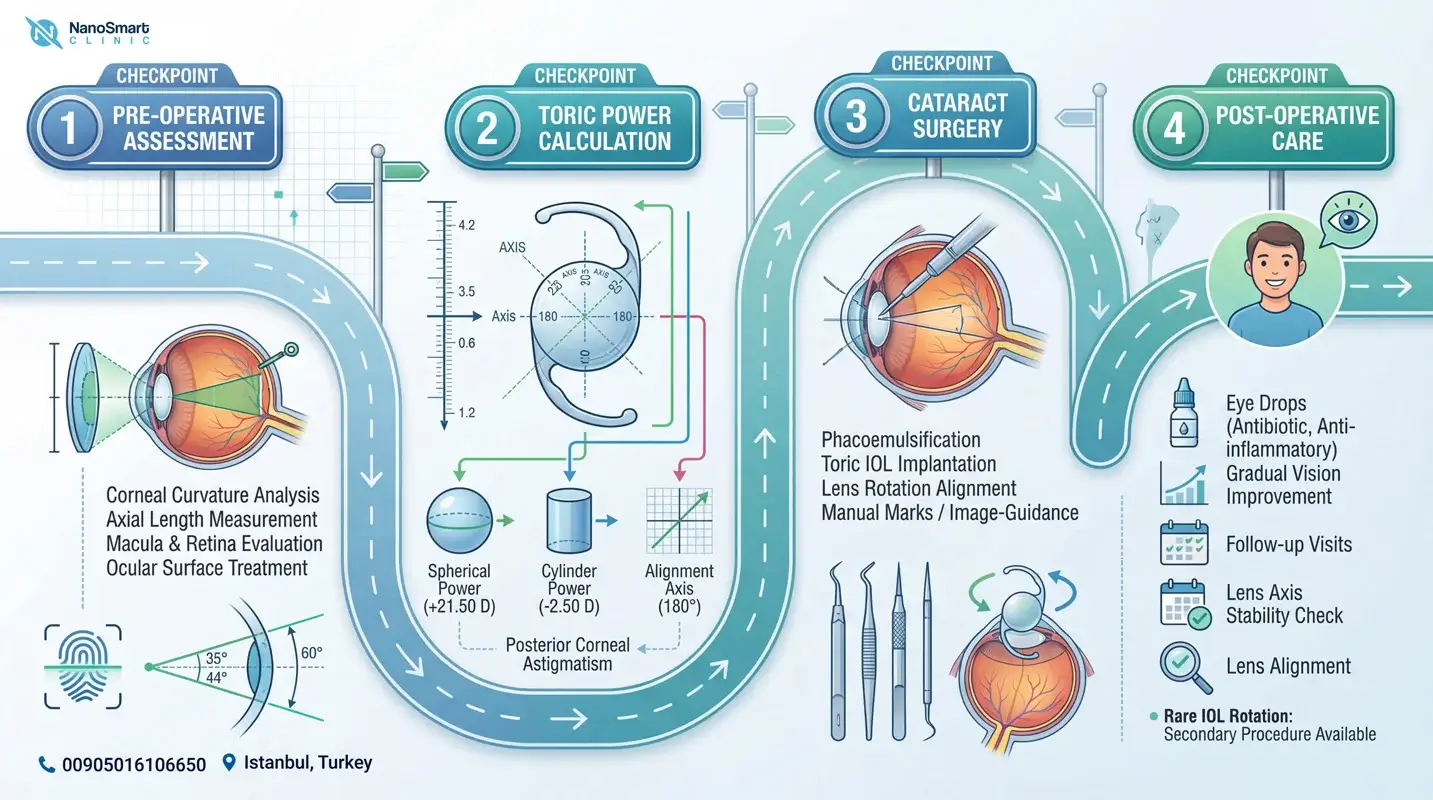
1. Pre-operative assessment
Before recommending a Toric IOL, your eye surgeon will usually:
Measure your corneal curvature (keratometry, topography or tomography)
Measure axial length and other biometric parameters
Evaluate the macula, retina and optic nerve
Treat or stabilize ocular surface issues (e.g., dry eye) if needed
2. Toric power calculation
Special Toric IOL calculators are used to determine:
The appropriate spherical power
The cylinder (astigmatic) power
The axis at which the lens should be aligned inside the eye
Modern calculators may include posterior corneal astigmatism and surgically induced astigmatism to reduce residual error.
3. Cataract surgery with Toric IOL implantation
Surgery is usually performed under local anesthesia with eye drops:
The cloudy lens is removed through a small incision (phacoemulsification)
The Toric IOL is inserted into the capsular bag
The surgeon rotates the lens so that the alignment marks on the IOL match the pre-planned astigmatism axis using manual marks or digital image-guidance systems
4. Post-operative care and follow-up
After surgery, you can expect:
Eye drops (antibiotic, anti-inflammatory, lubricating) for several weeks
Gradual improvement in vision over days to weeks
Follow-up visits to confirm that the lens axis is stable and residual astigmatism is minimal
If significant IOL rotation occurs (uncommon), it can often be corrected by a short secondary procedure to re-align the lens.
Benefits and limitations you should know about
Key benefits of Toric IOL lenses for astigmatism
Evidence across multiple trials and reviews shows that Toric IOL lenses for astigmatism:
Provide better uncorrected distance vision than standard monofocal lenses in eyes with pre-existing astigmatism
Leave less residual corneal astigmatism, particularly when the pre-operative astigmatism is ≥ 1.0–1.5 D
Increase spectacle independence for distance
Have similar safety and optical quality (e.g., contrast sensitivity, higher-order aberrations) as non-Toric monofocal IOLs
Limitations and risks
At the same time, it’s important to have realistic expectations:
Rotational sensitivity – if the lens rotates off-axis, some of its astigmatic correction is lost. Even so, typical rotations of only a few degrees lead to relatively small reductions in effect, and modern designs show good rotational stability.
Need for precise measurements – inaccurate keratometry or unaddressed dry eye can lead to residual astigmatism.
Cost – Toric IOLs are usually classified as a “premium” upgrade and may have additional out-of-pocket cost compared with standard IOLs, although cost-effectiveness studies suggest good long-term value due to reduced dependence on glasses.
May still need mild glasses – some patients will still use glasses for specific tasks (e.g., night driving, prolonged reading), especially if they have presbyopia or other ocular comorbidities.
Is a Toric IOL right for you? Practical signs to discuss with your doctor
You are more likely to benefit from Toric IOL lenses for astigmatism if:
Your glasses prescription shows a significant cylinder (astigmatism)
Topography confirms regular corneal astigmatism ≥ ~1.0 D
You are scheduled for cataract or lens surgery
You strongly prefer clearer distance vision with minimal or no glasses
Your retina and optic nerve are healthy enough to support good visual potential
You may need alternative or combined strategies if:
You have irregular astigmatism or advanced keratoconus
There are significant retinal diseases, optic nerve damage, or unstable eye conditions
Your ocular surface (dry eye, inflammation) is not yet under control
Ultimately, the decision is personalized and should be made together with your cataract surgeon after a full clinical evaluation.
FAQ – Toric IOL lenses for astigmatism
1. Are Toric IOLs really better than standard monofocal lenses for astigmatism?
Yes. Systematic reviews and meta-analyses show that Toric IOL implantation produces better uncorrected distance vision and less residual astigmatism than standard monofocal IOLs in cataract patients with pre-existing corneal astigmatism.
2. From what level of astigmatism do guidelines suggest Toric IOLs?
ESCRS guidelines recommend considering Toric IOLs in eyes with regular corneal astigmatism of 1.0 diopter or more, with the greatest benefit typically seen when corneal astigmatism exceeds 2.0 diopters.
3. What happens if the Toric IOL rotates after surgery?
Small rotations are expected and usually have minimal clinical impact, especially with modern designs showing good stability. If a lens rotates significantly and causes noticeable visual degradation, surgeons can often re-align it in a short secondary procedure.
4. Will a Toric IOL also fix my reading vision?
A standard monofocal Toric IOL is primarily designed for one focal distance (usually far). It corrects astigmatism at that distance, but does not eliminate presbyopia, so you may still need reading glasses for near tasks. There are multifocal or extended-depth Toric IOLs that address both distance and near, but they involve additional trade-offs, such as potential halos or glare, and must be selected carefully.
5. Are Toric IOLs suitable for older patients?
Age alone is not a contraindication. Studies including older patient groups show that Toric IOLs can deliver improved unaided vision and reduced residual astigmatism, often with good cost-effectiveness, provided the eye is otherwise healthy and visual potential is good.
Find out if Toric IOL lenses for astigmatism are the right choice for your eyes at Nano Smart Clinic
If you live with astigmatism and are planning cataract or lens surgery, your choice of lens will shape your vision for years to come. Choosing Toric IOL lenses for astigmatism is not just a cosmetic “upgrade” – it’s a medical decision that can dramatically improve how clearly you see the world.
At Nano Smart Clinic – Istanbul, we provide a complete Toric IOL pathway:
Advanced diagnostics (corneal topography, biometry, macular and nerve evaluation)
Evidence-based planning using established Toric IOL calculators and guidelines
Experienced cataract surgeons familiar with Toric alignment techniques and image-guided systems
Transparent discussion of your options (standard, Toric, and other premium lenses) so you can make an informed choice
📩 Book your Toric IOL assessment at Nano Smart Clinic today:
Fill out the online consultation form and mention that you have astigmatism and are interested in Toric IOL options, or
Contact our medical coordinator via WhatsApp to share your reports and get a personalized pre-evaluation before you travel
Your vision deserves precision. Toric IOL lenses for astigmatism may be the key to moving from blurred, distorted images to clear, comfortable sight in your everyday life.