PRK Eye Surgery in Istanbul
PRK eye surgery in Istanbul is a flap-free laser vision correction option for people with thin corneas and active lifestyles who want to get rid of glasses safely.
If you’re tired of glasses and contact lenses but were told you’re “not a good candidate for LASIK” because of thin corneas or your job/activities, PRK (Photorefractive Keratectomy) may be the right solution for you.
This guide explains, in clear and honest language:
What PRK is and how it works
Who is a good candidate for PRK
How PRK compares to LASIK / Femto LASIK
Benefits, risks, and recovery timeline
Why many eye doctors still choose PRK in specific cases
What Is PRK (Photorefractive Keratectomy)?
PRK (Photorefractive Keratectomy) is a type of laser refractive surgery used to correct vision problems caused by refractive errors, such as nearsightedness (myopia), farsightedness (hyperopia), and astigmatism.
Like LASIK, PRK reshapes the cornea using an excimer laser so light can focus correctly on the retina. The key difference:
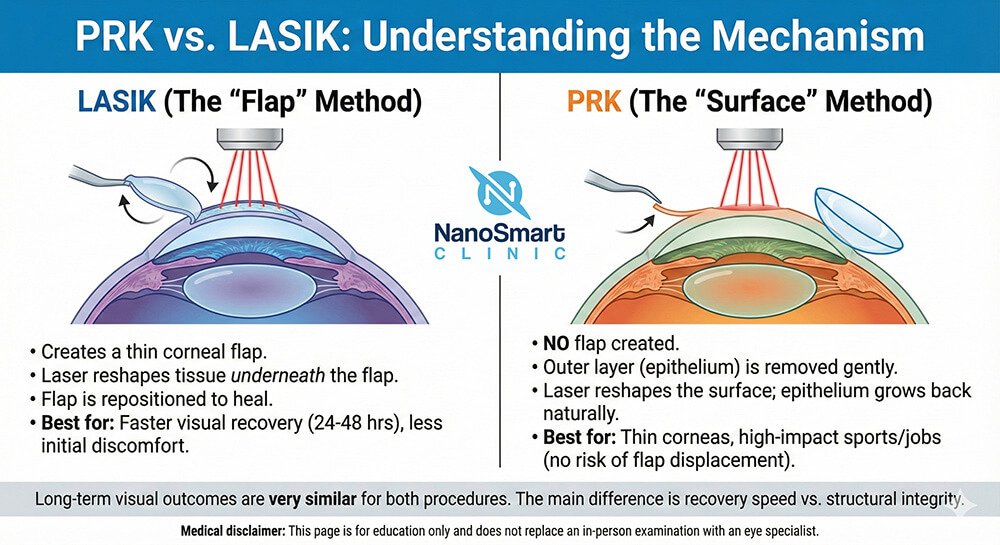
LASIK: A thin corneal flap is created, the laser works underneath, and the flap is repositioned.
PRK: No flap is created. Instead, the thin outer layer of the cornea (epithelium) is gently removed, the laser reshapes the surface, and then the epithelium grows back naturally over a few days.
PRK can effectively correct:
Myopia (short-sightedness)
Hyperopia (long-sightedness)
Astigmatism
Who Is a Good Candidate for PRK?
According to major eye-care organizations, PRK is often recommended in cases where LASIK is not ideal, especially for:
Thin corneas where creating a LASIK flap would remove too much tissue
People in contact sports or high-impact professions (military, fighters, some athletes) where eye trauma is more likely – because PRK is flap-free
Patients with certain superficial corneal irregularities or scars
People with refractive errors within a safe correction range, after full testing
When PRK Might Not Be Recommended
PRK may not be suitable if you have:
Keratoconus or significantly irregular corneas
Active eye infections or severe dry eye disease that cannot be controlled
Autoimmune conditions that impair healing
Unstable vision or uncontrolled systemic diseases
The final decision is always made by your refractive surgeon after detailed tests (corneal thickness, topography, tear film, retinal exam, etc.).
How PRK Is Performed – Step by Step
Based on trusted sources such as the American Academy of Ophthalmology and major eye hospitals:
Topical anesthesia
Numbing eye drops are applied so you don’t feel pain during the procedure. A mild sedative may be offered if needed.Removing the epithelium
The surgeon gently removes the thin surface layer of the cornea (epithelium), either with a special instrument or an alcohol solution.Laser reshaping
An excimer laser precisely reshapes the corneal tissue based on your prescription. This usually takes seconds per eye.Bandage contact lens
A soft “bandage” contact lens is placed on the eye to protect the surface and reduce discomfort while the epithelium grows back.Post-operative medications
You’ll use antibiotic drops, anti-inflammatory drops, lubricating drops, and pain medication as prescribed.
The procedure is typically done on an outpatient basis and takes only a few minutes per eye.
PRK Recovery Timeline – What to Expect
Days 1–5: Early Healing
Blurry or hazy vision
Light sensitivity
Gritty or burning sensation in the eye
These symptoms usually improve as the epithelium regenerates over 3–5 days.
Weeks 1–4: Functional Vision
Vision becomes good enough for most daily activities
Many patients can return to office-type work within about 5–7 days, once their doctor clears them
Light halos or fluctuating clarity may still appear, especially at night
1–3 Months: Final Stabilization
The cornea continues to smooth and stabilize
Visual acuity continues to sharpen
Studies show that long-term visual outcomes of PRK and LASIK are very similar when patients are properly selected and follow instructions.
So the main difference is not the final result, but speed of recovery and early comfort.
PRK vs. LASIK / Femto LASIK – Key Differences
Technique
LASIK / Femto LASIK:
A flap is created in the cornea (with a microkeratome or femtosecond laser)
Laser reshaping is done under the flap
Flap is repositioned
PRK:
No flap
Epithelium is removed, laser reshapes the surface, epithelium regrows
Recovery Speed & Comfort
LASIK:
Fast visual recovery (often within 24–48 hours)
Less early discomfort
PRK:
Slower recovery (days to weeks for vision to feel “normal”)
More discomfort in the first 2–4 days
But with similar long-term vision outcomes
Safety in Trauma-Prone Eyes
Because PRK does not create a flap, it avoids very rare flap-related issues if the eye is hit or injured later in life. This is why PRK is often preferred for:
Contact sports athletes
Military personnel
People in high-risk jobs for eye trauma
Benefits of PRK
From clinical studies and expert guidelines:
Flap-free procedure – no risk of flap displacement
Excellent long-term visual results comparable to LASIK
Ideal option for patients with thin corneas or certain corneal surface issues
Suitable for people with higher risk of eye trauma
Proven technology with more than 25+ years of clinical use
Risks and Possible Side Effects
All surgeries have risks. With PRK, potential issues include:
Pain or discomfort in the first few days
Temporary blurred / fluctuating vision
Light sensitivity, halos, or glare – especially at night during early healing
Dry eye symptoms
Corneal haze (cloudiness) in a minority of cases – risk reduced with modern protocols
Under-correction or over-correction (may occasionally require enhancement)
Choosing an experienced refractive surgeon and following all aftercare instructions significantly reduces these risks.
How to Prepare for PRK – And What to Do After
Before Surgery
Stop contact lenses for a period recommended by your doctor (varies by lens type)
Tell your doctor about all medications and any medical conditions (especially autoimmune disease, pregnancy, breastfeeding, uncontrolled diabetes)
Use any pre-operative drops exactly as prescribed
After Surgery
Use all eye drops (antibiotic, anti-inflammatory, lubricating) on schedule
Avoid rubbing your eyes
Wear sunglasses outdoors to reduce light sensitivity
Avoid swimming pools, hot tubs, and eye makeup for the period your doctor recommends
Attend all follow-up visits – especially within the first week and first month
Long-term success is a combination of good surgery + good aftercare + realistic expectations.
PRK at Nano Smart Clinic – Istanbul
Flap-Free Vision Correction with Complete Medical Support
At Nano Smart Clinic – Istanbul, we treat vision correction as a full journey, not just a quick procedure:
Comprehensive pre-operative assessment with advanced diagnostic imaging
Honest recommendation between PRK, Femto LASIK, Smart Lens, or other options based on your corneal thickness, prescription, and lifestyle
Clear explanation of benefits, risks, and recovery in language you can actually understand
Continuous follow-up after surgery to ensure safe healing and stable results
Conversion-Focused CTA for PRK – Nano Smart Clinic
Still not sure whether you’re a candidate for LASIK or PRK?
Let our eye specialists at Nano Smart Clinic evaluate your eyes and design a tailored vision correction plan for you
Start your journey to clearer vision without glasses – with a flap-free PRK solution and expert care at Nano Smart Clinic, Istanbul.
📩 Book your free initial assessment now at Nano Smart Clinic: