Trifocal IOL Smart Lenses: A Complete Guide for Spectacle-Free Vision
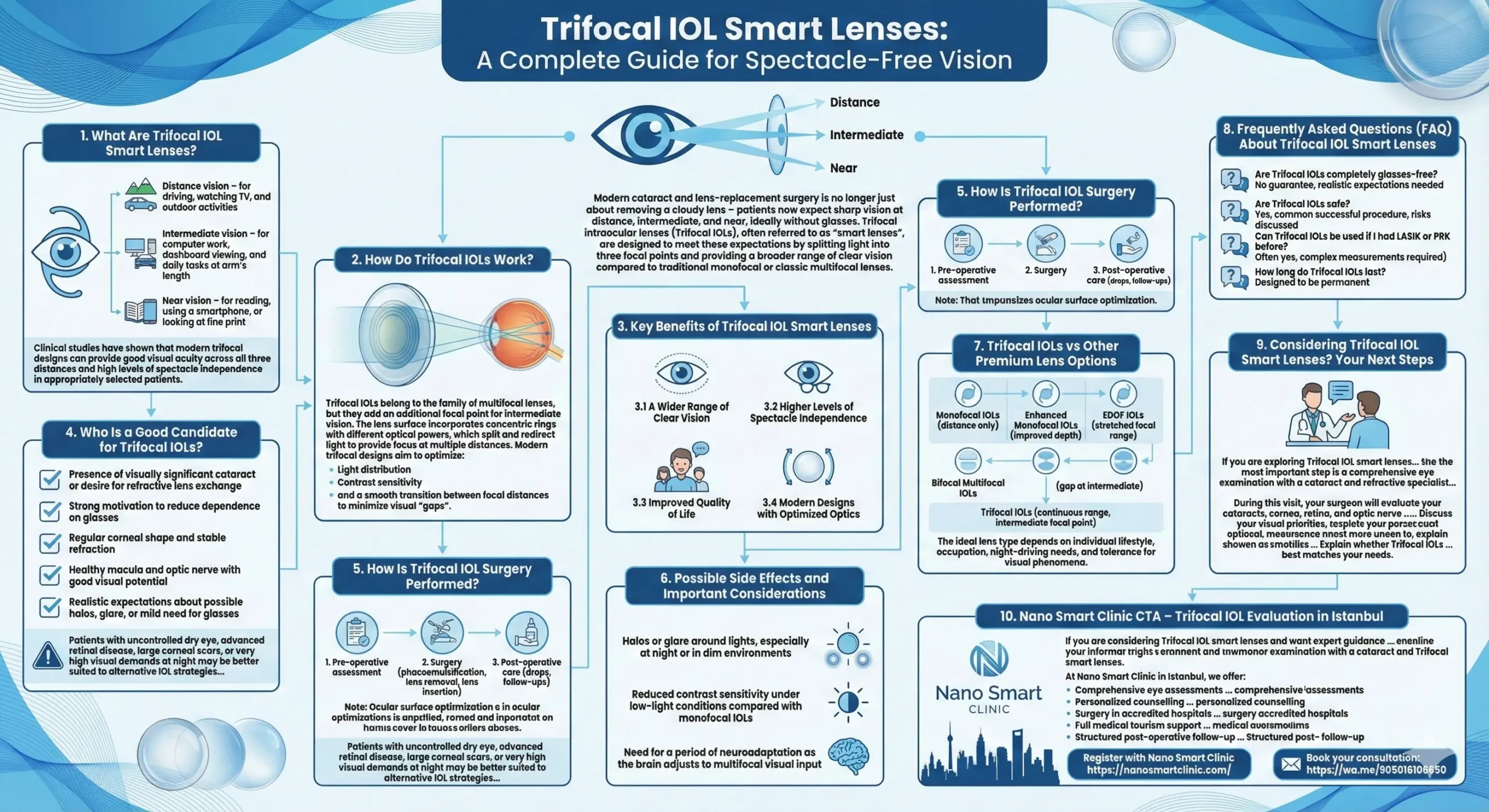
Modern cataract and lens-replacement surgery is no longer just about removing a cloudy lens. Today, many patients expect sharp vision at distance, intermediate, and near, ideally without glasses. Trifocal IOL smart lenses were created to meet these expectations by splitting light into three focal points and providing a broader range of clear vision compared to standard monofocal or classic multifocal lenses.
This guide explains what Trifocal IOL smart lenses are, how they work, who they are suitable for, their key benefits and possible side effects, and what to expect before and after surgery. It is structured to be patient-friendly and search-engine-friendly at the same time.
1. What Are Trifocal IOL Smart Lenses?
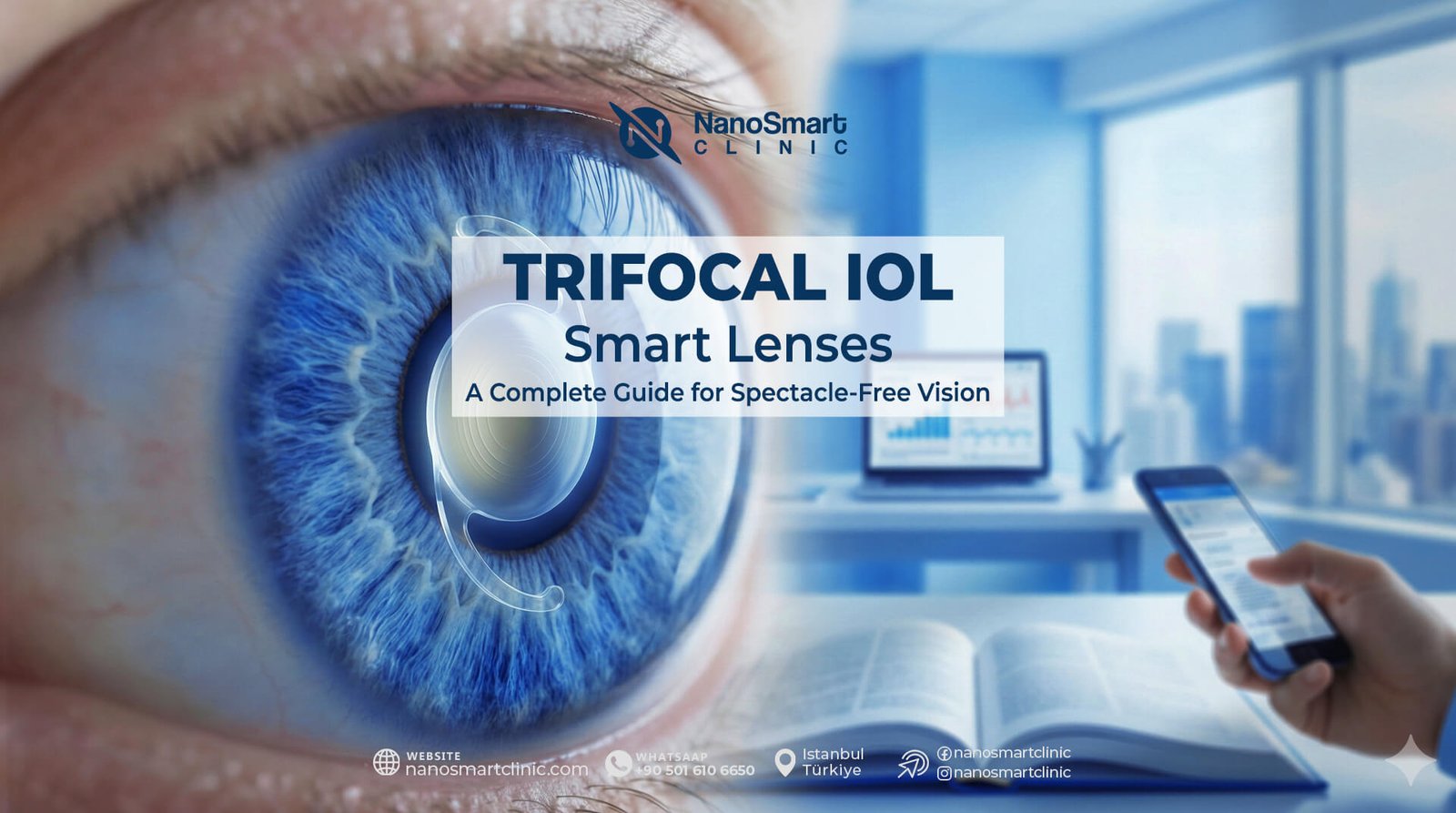
Trifocal IOLs are premium, presbyopia-correcting intraocular lenses that replace the eye’s natural lens during cataract surgery or refractive lens exchange. Unlike monofocal IOLs that provide clear vision at only one distance (usually far), trifocal lenses are engineered to deliver useful vision at three main ranges:
- Distance vision – for driving, watching TV, and outdoor activities
- Intermediate vision – for computer work, dashboard viewing, and daily tasks at arm’s length
- Near vision – for reading, using a smartphone, and looking at fine print
These Trifocal IOL smart lenses use sophisticated diffractive optics to distribute incoming light across far, intermediate, and near focal points. With careful patient selection and accurate surgical planning, many patients can achieve a high degree of spectacle independence after surgery.
2. How Do Trifocal IOL Smart Lenses Work?
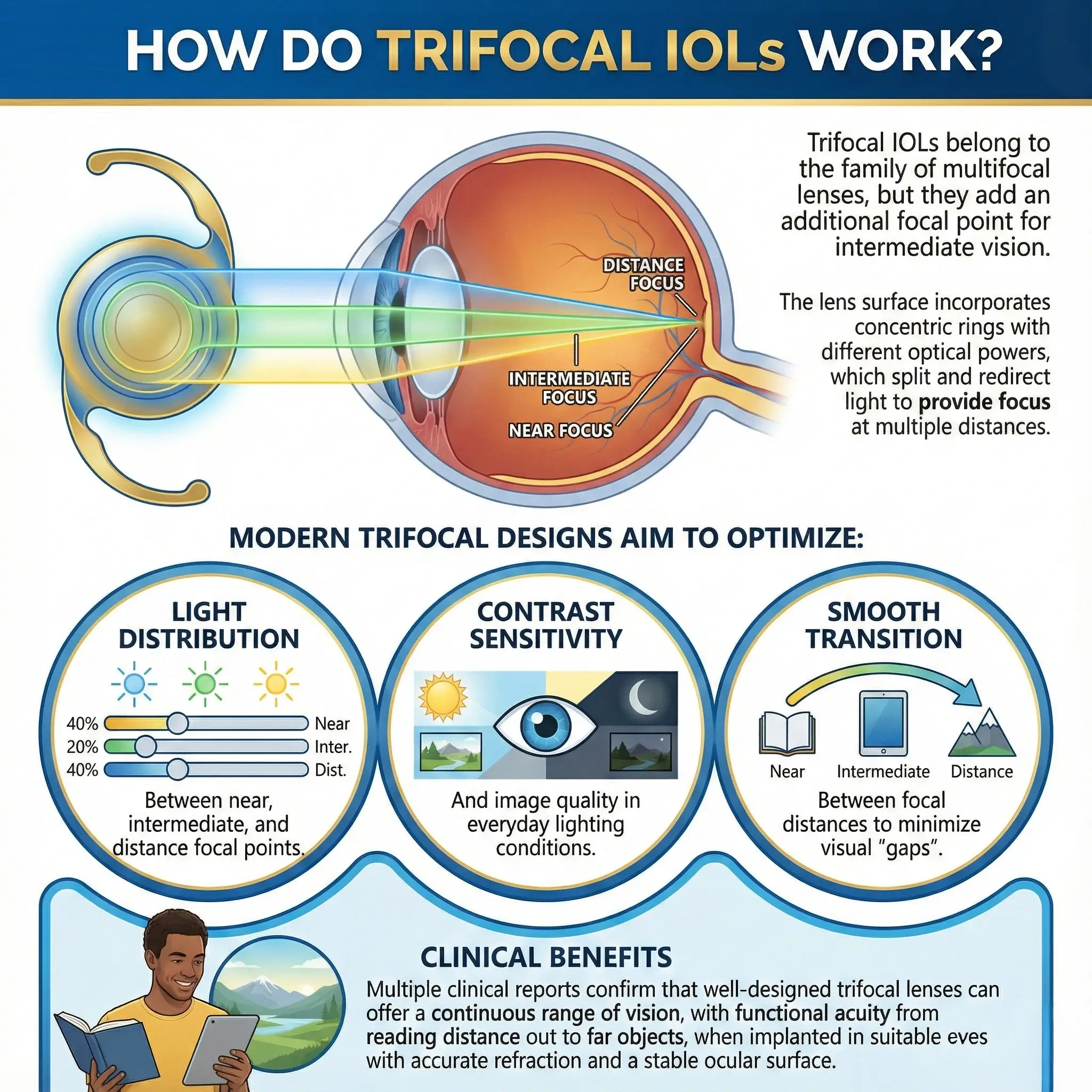
Trifocal IOLs belong to the family of multifocal lenses but add an extra focal point for intermediate vision. The surface of the lens incorporates concentric rings with different optical powers, which split and redirect light to provide focus at multiple distances.
Modern trifocal designs aim to optimise:
- Light distribution between near, intermediate, and distance focal points
- Contrast sensitivity and image quality in everyday lighting conditions
- Smooth transitions between distances to minimise “gaps” in functional vision
When the ocular surface is healthy and biometry is accurate, Trifocal IOL smart lenses can provide a continuous range of useful vision from reading distance out to far objects, allowing many patients to work on a computer, drive, and read without changing glasses all day.
3. Key Benefits of Trifocal IOL Smart Lenses
3.1 A Wider Range of Clear Vision
Trifocal lenses are designed to provide good visual acuity at far, intermediate, and near. Compared with classic bifocal designs, trifocal lenses typically offer better intermediate vision, which is crucial for working on a laptop, cooking, using a tablet, and many modern daily activities.
3.2 Higher Spectacle Independence
Because trifocal lenses correct presbyopia and can also be combined with toric technology to treat corneal astigmatism, they can significantly reduce the need for glasses after cataract or lens surgery. Many patients reach a point where they can manage most daily tasks without spectacles, or they may only use mild glasses for very specific situations.
3.3 Improved Quality of Life
For suitable candidates, Trifocal IOL smart lenses can translate into more visual freedom, fewer limitations in social and professional activities, and reduced dependence on reading or progressive glasses. This often leads to higher satisfaction and a better perceived quality of life after surgery.
3.4 Modern Designs with Optimised Optics
Latest-generation trifocal lenses use refined diffractive profiles, aspheric surfaces, and optimised light distribution to enhance image quality and reduce unwanted visual phenomena compared with older multifocal designs. Lens manufacturers continue to refine these optics to provide more natural, comfortable vision in real life.
4. Who Is a Good Candidate for Trifocal IOL Smart Lenses?
Trifocal IOLs are powerful tools, but they are not ideal for every eye. Careful patient selection is essential. In general, good candidates share several features:
- A visually significant cataract or a strong desire for refractive lens exchange
- Motivation to reduce dependence on glasses for both reading and distance tasks
- Regular corneal shape and stable refraction (no advanced keratoconus or major irregularities)
- A healthy macula and optic nerve with good visual potential
- Realistic expectations about possible halos, glare, or the need for mild glasses in some conditions
Patients with uncontrolled dry eye, advanced retinal disease, large corneal scars, or extremely high night-vision demands (for example, professional night drivers or pilots) may be better suited to alternative lens strategies such as enhanced monofocal or extended depth-of-focus (EDOF) IOLs. A detailed consultation with an experienced cataract and refractive surgeon is always required before making a final decision.
5. How Is Trifocal IOL Surgery Performed?
5.1 Pre-Operative Assessment
Before surgery, your eye specialist will perform:
- Full eye examination with refraction and visual acuity testing
- Biometry to measure eye length and corneal power
- Corneal topography or tomography to analyse the shape of the cornea
- Macular and optic nerve evaluation to rule out major retinal or nerve problems
- Ocular surface evaluation and treatment if dry eye is present
This information is used to calculate the appropriate lens power and to confirm that Trifocal IOLs are safe and suitable for your eyes.
5.2 The Surgery
Surgery is usually performed under local or topical anaesthesia and takes a short time in experienced hands:
- A micro-incision is created in the cornea.
- The cloudy natural lens (cataract) is broken up and removed.
- The Trifocal IOL smart lens is inserted into the capsular bag and centred carefully.
Modern cataract surgery is typically a day procedure, and most patients go home the same day.
5.3 Post-Operative Care
After surgery, you will use antibiotic and anti-inflammatory eye drops for a few weeks. Vision usually improves over several days, with stabilisation over the following weeks. Follow-up visits check:
- Healing of the eye
- Visual acuity at different distances
- Position and stability of the lens
Some patients experience a period of neuroadaptation while the brain adjusts to multifocal visual input. This is normal and usually improves with time.
6. Possible Side Effects and Important Considerations
Like all presbyopia-correcting lenses, Trifocal IOL smart lenses involve some trade-offs. The most commonly discussed side effects include:
- Halos or glare around lights, especially at night or in dim lighting
- Reduced contrast sensitivity in low light compared with monofocal IOLs
- A period of adaptation while the visual system adjusts to multiple focal points
Most patients adapt well, especially if they were properly counselled before surgery and understand what to expect. However, patients who are extremely sensitive to visual disturbances or who require perfect night vision for professional reasons need very careful counselling and may be offered different lens options.
7. Trifocal IOL Smart Lenses vs Other Premium Lens Options
When correcting presbyopia at the time of cataract surgery, surgeons can choose from several categories of premium lenses:
- Monofocal IOLs – sharp vision at one distance (usually far); reading glasses are still needed
- Enhanced or “monofocal-plus” IOLs – slightly extended depth of focus compared with standard monofocals, but not full multifocality
- Extended Depth-of-Focus (EDOF) IOLs – provide a stretched focal range for distance and intermediate vision with relatively fewer halos; reading glasses may still be needed for small print
- Bifocal multifocal IOLs – give good near and distance vision, but may leave a “gap” at intermediate distances
- Trifocal IOL smart lenses – specifically add an intermediate focal point, aiming to cover near, intermediate, and distance more smoothly and maximise spectacle independence
The ideal choice depends on lifestyle, night-driving needs, visual priorities, and tolerance for halos or glare. Trifocal IOLs are often chosen for active, multitasking patients who want the highest chance of functioning without glasses for most of the day.
8. Frequently Asked Questions (FAQ) about Trifocal IOL Smart Lenses
8.1 Will Trifocal IOL Smart Lenses Make Me Completely Glasses-Free?
Many patients achieve a high level of spectacle independence after Trifocal IOL implantation, but no lens can guarantee 100% glasses-free vision in every situation. Some people still use glasses for very fine print, prolonged reading, or specific tasks at night. Setting realistic expectations is essential for satisfaction.
8.2 Are Trifocal IOLs Safe?
Trifocal lenses are implanted using the same surgical techniques as standard cataract surgery, which is one of the most successful procedures worldwide. When surgery is performed by an experienced surgeon and the patient is properly selected, trifocal implantation is considered safe and effective. Like any intraocular surgery, there are risks, which should be discussed in detail during your pre-operative consultation.
8.3 Can I Have Trifocal IOLs If I Had LASIK or PRK Before?
In many cases, yes – but previous laser vision correction makes the calculations more complex. Special formulas and detailed corneal analysis are required to choose the right lens power, and not every post-LASIK or post-PRK eye is an ideal candidate. A customised evaluation is always required.
8.4 How Long Do Trifocal IOLs Last?
Trifocal IOLs are designed to be permanent. Once implanted and stabilised inside the eye, they normally do not need to be replaced. In rare situations – such as a large refractive surprise, significant tilt, or persistent visual symptoms – an additional procedure or lens exchange may be considered.
9. Trifocal IOL Smart Lenses at Nano Smart Clinic – Istanbul
If you are considering Trifocal IOL smart lenses and want expert guidance, choosing the right clinic and surgical team is crucial.
At Nano Smart Clinic – Istanbul, we offer:
- Comprehensive eye assessments with advanced diagnostics (biometry, corneal topography, macular imaging)
- Personalised counselling on Trifocal, EDOF, Toric and other premium IOL options, based on your lifestyle and visual needs
- Surgery in accredited hospitals with experienced cataract and refractive surgeons
- Full medical tourism support, including VIP airport transfers, hotel arrangements, and multilingual patient coordinators
- Structured post-operative follow-up and online check-ins after you return home
Register for Your Trifocal IOL Evaluation
 Book your Trifocal IOL assessment at Nano Smart Clinic today:
-
Fill out the online consultation form and mention that you have astigmatism and are interested in Trifocal IOL options, or
-
Contact our medical coordinator via WhatsApp to share your reports and get a personalized pre-evaluation before you travel